4 min read
7 Signs Your Dog is Uncomfortable Around Children
Dogs don’t always show stress around children in ways that are obvious. They do leave subtle cues, like when they turn away, lick their lips, or start getting stiff. These signs can signal that your dog is uncomfortable and needs a little more space. Knowing these warning signs can help prevent stressful interactions, keeping both children and your pup safe.

Contents
Our canine companions are part of our families and are often a wonderful part of a child’s world. For many reasons, it is essential for us as owners to be able to recognize and understand our dog’s behaviors. This is their way of communicating with us (although wouldn’t it be wonderful if they could talk?!).
One such reason, is so we know if they are feeling stressed. Particularly if they are feeling this way around children. If you don’t have children (or don’t have children in your family, either), there is still a high chance that your dog will cross paths with one at some point in their life, for example while out on a walk.
Children are often very interested in dogs, and share similar interests, including toys and food. Unintentionally, they can often act erratically and inappropriately around dogs and can behave in a way that a dog can perceive as a threat as a result.
A key part of managing their interactions, is ensuring the child/children behave appropriately around the dog.
You should always be asked for consent by the parent or guardian for the child to interact with your dog, and ideally, let your dog choose whether they want to interact with the child or not. If they do, you may see them approach the child in a relaxed manner and possibly nudge them gently.
Nevertheless, throughout the interaction, you should still keep an eye on your dog’s behavioral signs, and act as necessary to prioritize the safety of everyone.
Before we get into the specific depths of behavioral signs, we’d like to introduce you to something called the ‘Ladder of Communication’. A leading veterinary charity, the PDSA, designed this.
The concept is that dogs initially begin showing behavioral signs when they start feeling stressed and anxious. If these are ignored, their behavior will escalate (“climb the ladder”) to more serious behaviors, such as biting.
So, what behavioral signs should you look out for? Some are more subtle than others, but once you know what to look for, you’ll be a pro in no time! The behaviors you may see are the same as what you’d see if your dog was stressed in another situation. So, it’s a pretty handy skill to have in your armor.
Changes in Eyes

Have you ever heard of the saying, “the eyes are the window to the soul”? Just like us, their eyes can tell a story of how they are feeling. If they’re feeling stressed, you may see the whites of their eyes, notice them blinking rapidly, and/or see their pupils have dilated.
Sometimes, they squint their eyes or give you ‘side-eye’ to tell you they’re starting to feel uncomfortable.
Changes in Ears

Dog’s ears come in many different shapes and sizes, from floppy to upright. Just like their eyes, the position of their ears can indicate how they’re feeling.
If your dog is holding their ears back and/or flat to their head, this likely means they are feeling stressed.
Their Mouth

This may seem a pretty general sign, but just because they can’t talk, doesn’t mean their mouth can’t communicate! Some behavioral signs you may notice your dog doing if they are feeling stressed include prolonged yawning, licking their lips and drooling.
If these signs are not noticed, or ignored, this is when they ‘climb the ladder’ and may start showing their teeth or biting.
It goes without saying, dog bites can be serious. Feeling highly stressed can lead to this if steps aren’t taken to resolve the situation causing them to feel that way.
Changes in Body Posture

Body language is a key way us as humans communicate and it isn’t any different for our canine companions. How they hold themselves and move around can give us a real insight into how they are feeling.
If they are feeling stressed, you may see them become tense, hold their body low or cower, tuck their tail between their legs, turn their head away and pace around.
Panting & Vocalising

Dogs can pant when they are excited or feeling hot, but they can also do it when they are stressed. So, assess the situation they are in and note any other behavioral signs they’re showing to determine if it is indeed stress they are feeling.
Your dog may also vocalize if they are feeling stressed. This could be barking persistently, but progress to growling if they continue to feel stressed by the situation.
Vocalizing can be worrying for young children. So can other behavioral signs, and their reaction can sometimes exacerbate the dog’s feelings, albeit unintentionally. Therefore, it is always best to disseminate a situation before it gets heated.
Displacement Behavior

To get out of a stressful situation, dogs may escape to somewhere safer, or if they can’t physically move away easily, they may begin focusing on something else. This is known as displacement behavior and is commonly seen when dogs are feeling stressed.
They may begin sniffing their surroundings, grooming themselves, or actively looking and paying attention elsewhere. If this does happen, respect their choice to do this.
Give them space, as they’re trying to tell us they don’t wish to interact with the child or be in that situation.
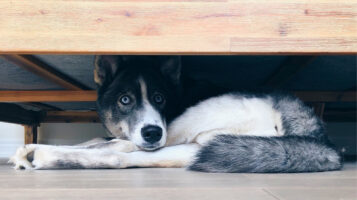
Hiding

Similar to escaping, some may stay close by but hide, either behind you or another safe person or object. They may also nudge you, firstly to get your attention, but also to prompt you to take you both away from the situation.
Young children can be at a greater risk with dogs, as they can be unpredictable and when expressing their emotions, be loud and explore through touch.
Dogs can find this threatening and stressful, and if the signs of them feeling stressed are not noticed or ignored, they may react defensively.
Hopefully, now you’re equipped with how to spot if your dog is feeling this way, such situations can be managed or avoided as necessary.
Some top tips to help keep your dog and children safe around each other:
Respect Their Space
Respect their space and this includes when greeting a dog. Approach them calmly, without invading their personal distance, where possible, allow the dog to approach the child.
Monitor Their Behavior
Continually monitor their behavior throughout the interaction, and deal with any unwanted behavior (from the dog or the child) immediately.
Supervise Interactions
Supervise every interaction. It’s best not to leave them unattended, even for a few minutes!
Socialize Them
If you have a puppy, socialize them around children as this may reduce any stress they feel when they are an adult.
Avoid Sharing Resources
Avoid sharing resources (e.g. toys) and do not disturb a dog when they are eating or sleeping.
Give Consent When Appropriate
You know your dog better than anyone. Ensure you consent to any child interacting with them first.
If the behavior persists in these situations, we recommend speaking with a vet so medical problems can be ruled out, or a qualified behaviorist can be consulted.
Make us part of your pack when you search.
Add Caninely as a preferred source on Google and we'll be right there next time you go searching. Five seconds, and you get straight dog talk instead of the usual fluff.


11 Tips For Treating Separation Anxiety in Dogs
Does your dog suffer from separation anxiety? Has your daily life become a little unpredictable as a result of your pup's nervous behavior? Believe it or not, this condition is quite common. In this article, Dr. Corinne Wigfall shares her top tips for keeping your dog calm instead of anxious.