4 min read
Saint Bernard: Breed Characteristics, Care, and Photos
Saint Bernards are gentle giants with a clock that runs fast. Drool, dysplasia, heatstroke risk, and a heart of gold. Here's the honest version, from someone who actually owns one, and the unflattering parts most breed profiles skip.

Contents
The Saint Bernard is the breed everyone thinks they know. Big, fluffy, brandy barrel around the neck, rescuing lost travelers in the Alps. Half of that is myth, the rest is half-true, and almost none of it prepares you for what actually owning one is like.
These are massive, slobbery, deeply affectionate dogs with a clock that runs faster than most owners are ready for and a price tag, emotional and financial, that catches people off guard.
I have a Saint Bernard named Maja, so I’ll spare you the romantic version. Saints are gentle to the point of being almost comically careful around kids. They’re loyal to their people, mostly mellow indoors, and built like a piece of furniture you have to walk around.
They also drool on the walls, blow their coat in clumps the size of small mammals, and turn into a heat-stricken puddle if the thermostat hits 80. If you want the truth about the breed instead of the postcard, keep reading.
Breed Overview
Breed Pros and Cons
Pros
- Gentle, patient temperament
- Amazing with children
- Calm, low-key indoors
- Deeply loyal and affectionate
- Thrives in cold climates
- Moderate exercise needs
Cons
- Short lifespan (8-10 years)
- Massive drool output
- Hip dysplasia risks
- Dangerously heat-sensitive
- Expensive to feed and treat
- Heavy seasonal shedding
Physical Attributes & Appearance

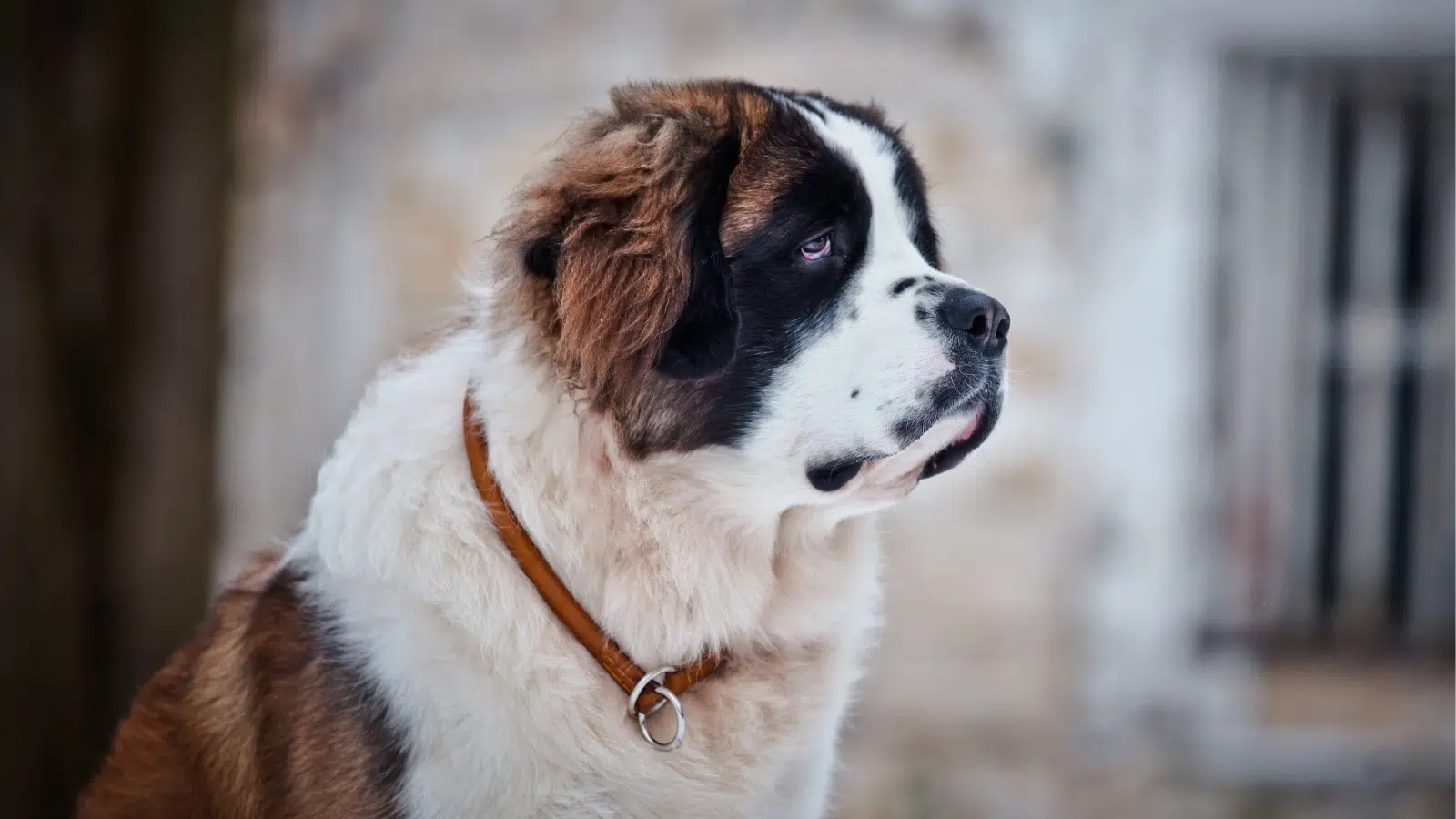
Saint Bernards are massive. Males stand 28 to 30 inches at the shoulder and routinely weigh 140 to 180 pounds. Females are 26 to 28 inches and 120 to 140. The breed comes in two coat varieties: short-haired (smooth) and long-haired (rough). Both have the same dense undercoat and the same iconic markings. White base with red, brown, or brindle patches, a dark mask around the eyes, and that famously expressive face.
The head is the breed’s signature. Massive skull, pronounced brow, deep-set dark eyes, and the loose flews (jowls) that produce the legendary drool. Saints have heavy bone, thick legs, and broad chests. They’re not built for speed.
They’re built to plow through snow and pull weight, which is exactly what they were originally bred to do. Maja’s smooth-coated, and even she leaves a fur halo on every couch in the house.
Behavioral Characteristics & Temperament

Saint Bernards are nanny dogs. That’s not me romanticizing it. It’s the temperament that’s been bred into them for centuries. They’re patient, gentle, and almost preternaturally aware of their size around small humans. Maja moves like she’s negotiating a museum when there’s a kid in the room. Saints want to be where the family is, ideally lying across the doorway so nobody leaves without saying goodbye.
They’re also surprisingly stubborn. Saints aren’t dumb. They’re just selective about what’s worth their effort. A 150-pound dog who decides she’d rather not get up from the kitchen floor is a 150-pound problem. Training has to start in puppyhood, before they figure out they outweigh you. Positive reinforcement works. Force does not. Push a Saint and you’ll get a wall of fluff that pretends not to hear you.
Energy levels are low to moderate, which fools a lot of owners. Saints look like couch potatoes, and they often are. But they still need daily activity to stay healthy and mentally engaged. Without it, they get bored, gain weight, and develop joint problems faster than they already would. The breed is also slow to mature. Don’t expect adult behavior until two and a half or three.
Ideal Home Life

Saints want space, cool floors, and a family that’s home. Apartment life is technically possible but rough on everyone. These dogs need room to lay out, and you need room to walk around them. A house with a yard is the realistic baseline. They don’t need acreage. They need a place to flop without you tripping over them.
Climate is the make-or-break factor. Saints were bred for Alpine winters, and the same coat that lets them shrug off a snowstorm makes summer dangerous. Anything above 80°F is uncomfortable. Anything above 90°F is a real risk. I keep Maja inside on AC during Tennessee summers and walk her at sunrise or after sunset, period. If you live somewhere hot and you don’t have central air, this isn’t your breed. Trust me.
Exercise should be moderate and low-impact. A 30 to 45 minute walk plus some yard time is plenty for an adult. Puppies and adolescents need less intense activity than people assume.
Repetitive jumping, stair climbing, and forced running on growing joints is how giant-breed owners create lifelong hip problems they could have avoided. Keep it gentle until the growth plates close, around 18 to 24 months. The investment up front saves you a decade of vet bills.
Health Risks
Hip and Elbow Dysplasia
Saints are among the most hip-dysplastic breeds tracked by the OFA, with elbow dysplasia close behind. Both conditions cause joint malformation, pain, and progressive arthritis. Reputable breeders screen with OFA or PennHIP X-rays before breeding. If a breeder skips that step, the puppy is a gamble.
Bloat/Gastric Dilatation-Volvulus
Deep-chested giant breeds are at extreme risk for bloat, where the stomach fills with gas and twists on itself. It kills within hours without emergency surgery. Many giant-breed vets recommend a preventative gastropexy at the time of spay or neuter — it’s the single best insurance against the worst outcome.
Cardiac Disease
Dilated cardiomyopathy and other heart conditions are common in the breed. Annual cardiac checks become important after age five. Symptoms like exercise intolerance, coughing, or sudden fatigue should never be dismissed as “just slowing down with age.”
Entropion and Ectropion
The Saint’s loose facial skin causes the eyelids to roll inward (entropion) or droop outward (ectropion). Both can lead to chronic eye irritation, infections, and in severe cases, corneal damage. Surgical correction is sometimes needed.
Osteosarcoma
Bone cancer hits giant breeds at a much higher rate than smaller dogs. It usually shows up as a sudden limp or swelling in a leg and progresses fast. Early detection matters but the prognosis is rarely good. It’s one of the leading causes of death in the breed.
Heat Stroke
Saints are exquisitely heat-sensitive. Their thick coat, large body mass, and brachycephalic-leaning facial structure make heat dissipation hard. Heat stroke can kill a Saint Bernard at temperatures other dogs would shrug off. Air conditioning isn’t a luxury for this breed.
Epilepsy
Idiopathic epilepsy occurs at higher rates in Saints than in many breeds. Seizures usually start between one and five years old. Most cases are manageable with daily medication, but it’s a lifelong condition that requires monitoring.
Ear Infections
Heavy, drooping ears trap moisture and create a warm environment for bacteria and yeast. Weekly ear checks and occasional cleaning go a long way toward preventing the chronic infections that can otherwise become a recurring problem.
Projected Cost of Ownership

Owning a Saint Bernard is expensive in ways that catch first-time giant-breed owners by surprise. The food bill is real. Medications dosed by weight cost more. Boarding charges by weight class. And the bigger the dog, the bigger the surgery if something goes sideways. None of this should scare anyone off. It just needs to be planned for.
The numbers below reflect baseline annual costs for a healthy adult Saint. Emergencies and chronic conditions can add thousands more. Joint support for an aging Saint isn’t optional in my house, and most owners I know factor it in by age four or five at the latest.
| Expense | Initial | Monthly | Annual |
|---|---|---|---|
| Purchase | $1,500-$3,500+ | — | — |
| Supplies | $400-$800 | — | — |
| Food | — | $120-$200 | $1,440-$2,400 |
| Veterinary | $600-$1,200 | — | $500-$1,200 |
| Training | $150-$500 | — | Varies |
| Grooming | $50-$100 | — | $80-$120/session |
| Insurance | — | $70-$140 | $840-$1,680 |
| Boarding | — | Varies | $50-$90/day |
| Replacements | — | — | $200-$400 |
| TOTALS | $2,500-$5,000 | $190-$340 | $3,000-$5,700+ |
Food is where this breed punishes you. Adult Saints eat 6 to 10 cups a day of high-quality large-breed kibble. A 30-pound bag lasts about two weeks. Cheap food saves money up front and costs more in vet bills, so most experienced Saint owners don’t go that route. Premium large-breed formula is the floor.
Pet insurance is genuinely worth it for this breed. Between bloat surgery, joint surgery, and cancer treatment, a single major event can run $5,000-$15,000. Premiums are high because giant breeds are expensive to insure, but they’re nothing compared to writing a check at the emergency vet at 2 a.m.
History and Breed Origins

The Saint Bernard’s origin is one of the most romantic stories in the dog world, and most of it is actually true. The breed was developed by monks at the Great St. Bernard Hospice, a refuge in the Swiss Alps along a treacherous mountain pass that had been used by travelers since Roman times. The hospice itself was founded around 1050 by an Augustinian monk named Bernard of Menthon, who’d later be canonized.
The monks kept large mastiff-type dogs as guard and companion animals starting in the mid-1600s. By the early 1700s the dogs were accompanying monks on rescue missions, helping locate lost or buried travelers in the deep snow. Their thick coats, scenting ability, and remarkable cold tolerance made them naturals at the work. The breed is credited with saving more than 2,000 lives over roughly two centuries of service in the pass.
The famous brandy barrel? Pure invention. It came from a 19th-century painting by Sir Edwin Landseer titled “Alpine Mastiffs Reanimating a Distressed Traveler.” Landseer added the barrel for visual interest, and the legend stuck. Saint Bernards were officially recognized as a breed in Switzerland in 1880 and by the AKC in 1885. They’ve become a cultural icon ever since, helped along by Beethoven and a thousand kids’ movies.
Frequently Asked Questions
How long do Saint Bernards live?
The average lifespan is 8 to 10 years. Some Saints live longer with strong genetics, careful weight management, and good preventative care. The breed’s size is the main driver. Giant breeds simply don’t live as long as smaller dogs, and Saints sit at the top end of the size scale.
Do Saint Bernards drool a lot?
Yes. Aggressively. The loose flews on a Saint’s face produce serious drool, especially after eating, drinking, or any kind of excitement. Drool ropes get flung onto walls, ceilings, and unsuspecting visitors. Keep slobber rags in every room — that’s the actual workaround.
Are Saint Bernards good with kids?
Saints are famously gentle with children and have a long history as nanny dogs. The main caveat is size. A 150-pound dog can knock a toddler over without meaning to, especially during tail-wagging excitement. Supervision is essential, but the temperament is genuinely outstanding.
How much exercise does a Saint Bernard need?
Adult Saints need about 30 to 45 minutes of moderate exercise per day, plus access to a yard. Puppies need much less high-impact activity to protect their growing joints. Don’t let the lazy adult fool you. A Saint without daily activity gets bored, gains weight, and develops health problems faster.
Are Saint Bernards good for first-time dog owners?
Honestly, no. The temperament is forgiving, but the size, training requirements, drool, shedding, heat sensitivity, and health risks add up to a steep learning curve. Saints are an outstanding second or third dog. As a first dog, they overwhelm a lot of new owners.
Sources
Make us part of your pack when you search.
Add Caninely as a preferred source on Google and we'll be right there next time you go searching. Five seconds, and you get straight dog talk instead of the usual fluff.


21 Healthy Dog Breeds Vets Love (And 7 They Watch Closely)
Not all dog breeds are built the same. Some are genetically wired for long, active lives with far fewer trips to the vet. Here are 21 dog breeds veterinarians say have the fewest health problems, ranked by longevity, joint health, and overall resilience.